
A Living Legend: Mr. Pelz’s 50th Anniversary Interview
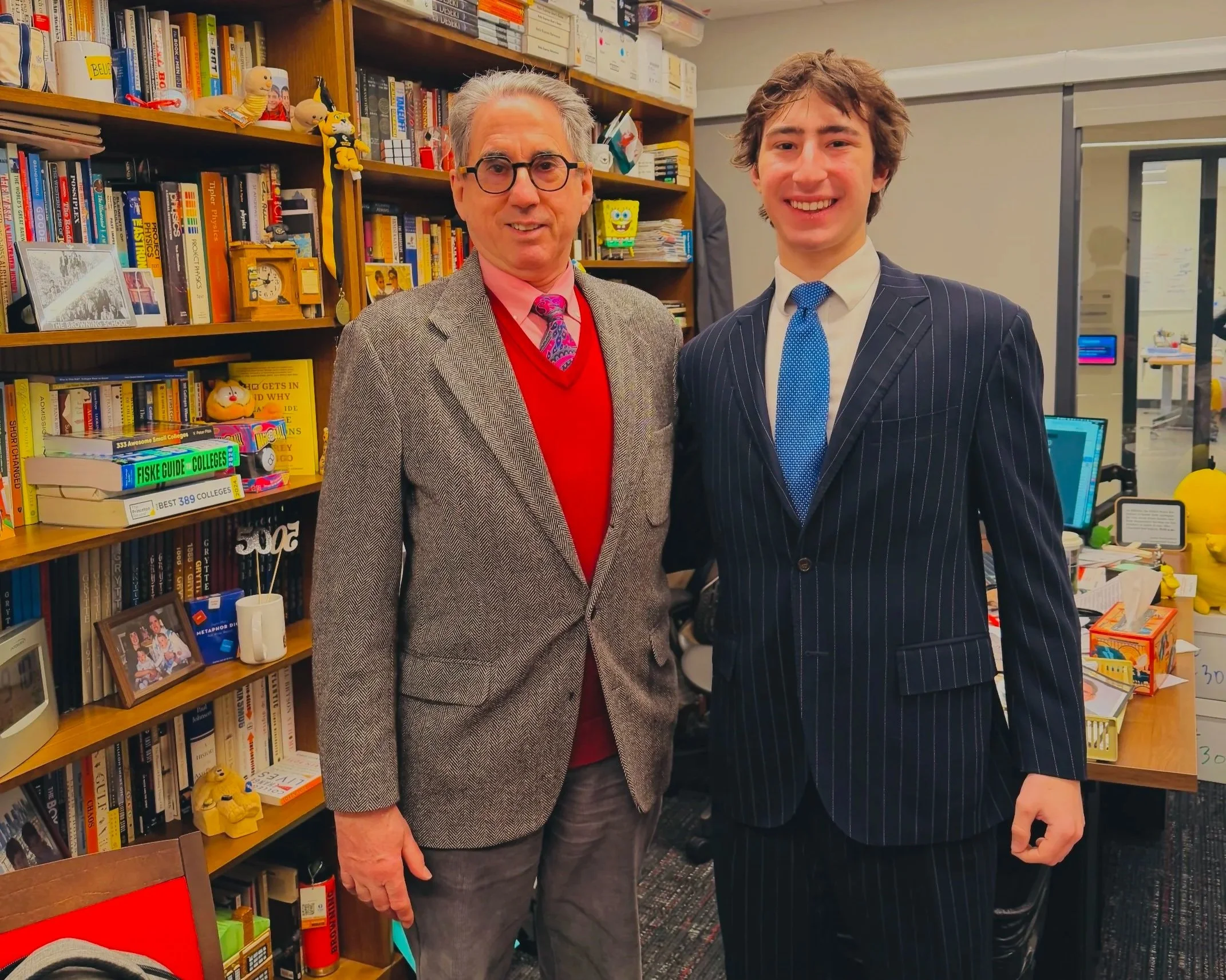
Mr. Pelz and Noah L '26 in Mr. Pelz’s 64th Street Office

Sandy M. Pelz '71 Pictured at his 50th Anniversary Celebration
Edited Interview between Noah L. '26 and Mr. Pelz '71
When you first walked in as a student, could you ever have imagined you'd be here a half-century later?
I came back to Browning right after I graduated college, and I wasn't expecting to stay more than a year or two. My plan was to teach for a couple of years and then apply to graduate school, get a PhD in physics, and teach at the university level. As I started taking graduate-level classes—the mathematical physics classes being particularly hard—I found that I just wasn't suited for teaching in higher education. But teaching high school was a different story; I was a good physics teacher.
What was Browning like when you were a student?
It was a lot of the same. It was an earlier time, so the things that made it different are things that were different in society.
There's one experience I had in my first year at the school with Mr. Cook, the headmaster at the time. At the noon dismissal for Thanksgiving vacation, one of my friends told me that my sister was downstairs waiting for me. She had been away at college since September, and I was terribly anxious to see her. She wasn't even supposed to be home until that night. Breathless with anticipation, I rushed down the stairs of what we then referred to as the "new building," converting five full stories of gravitational potential energy into kinetic energy. Needless to say, I was moving when I came down the last flight, with the door and the street in sight, and then—BAM. I ran headlong into Mr. Cook!
Now, your typical seventh grader isn't all that big, and Mr. Cook, well, was, so in spite of my high speed, I'm sure I lost the collision. I looked up to see his face turn crimson and start to twitch. My life flashed before my eyes... several times (I was only 11).
Mr. Cook grabbed me by the lapels and boomed, "What are you doing running down the stairs?" I sobbed, "My sister's waiting for me, I haven't seen her in months." He slammed me up against the wall (remember, these were the old days when you could hit students!). My private school career was over, I knew it. I had brought shame on my entire family. How do you find another school in November? I heard the voice again: "Don't you ever do that again!" And then he was gone. It was over.
I was still alive. I hadn't been expelled! However, the specter of the event managed to keep me out of (most) trouble for the next six years! It would be over ten years, though, before I would learn from Mr. Cook that he had absolutely no recollection of the event. He hadn't even known who I was!
What was college guidance like when you were a student?
College guidance, when I was a student, wasn't really a formal program. It was the head of the Upper School coming around to each of us saying, "You should be looking at this school or that school." It was kind of casual. And I think that was common in most independent schools and in most public schools. It probably just didn't exist as a career back then.
Do you remember your own experience applying to college?
I do remember. I went to a summer program at Colorado College between junior and senior years in physics and mathematics. I left Colorado College loving it, so it's the only place I applied to. I don't specifically remember what I wrote my college essay about. I did a blog where I said I wrote it about shoveling mud in the summer, which may have been what I wrote it about, but I'm not sure.
You graduated, went to college, and then you chose to come back to teach. What pulled you back?
I was offered a job. It was that simple. Time magazine was telling me 50% of my class was going to be unemployed, and the head of the Browning math department called me and said, "You want to come teach?" And I said, "Sure, I'll do that for a couple of years." That was it.
Do you remember your first classes and groups of students as a teacher?
I taught 10th, 11th, and 12th graders. I don't think I taught ninth grade my first year. I taught mathematics and physics. And yeah, I remember a lot of those kids. I had one class—algebra three—for kids who were not particularly good algebra students, and that was a challenging class. They were nice kids, delightful kids, but they weren't particularly good students, so it was kind of hard to teach them. But I remember geometry, I remember precalculus—I loved teaching precalculus—and I remember physics. I loved teaching physics.
How did you introduce yourself as a teacher?
Well, I was Mr. Pelz. It was a little bit of a challenge because I had at least one, maybe two, younger brothers of classmates. I was 21 years old, so I was three years older than some of the kids I was teaching. They knew me as Sandy because I was a classmate of their older brother, and that was a little bit of a challenge. But it worked out.
You've had many roles at Browning. Walk us through the different shoes you've worn as a faculty member. How did you find yourself being "the College Guy"?
I started out teaching math. I was hired as a math teacher. I volunteered to teach physics because it was my major. Somewhere in the first five or six years, I got tapped to do the schedule, so I started scheduling the entire school. Then I took on a little more science and a little less math. In the early 1980s, I was chair of the science department for a couple of years.
In 1988—our centennial year—Mr. Cook's last year as headmaster, Dr. Clement came in as head. At the end of that first school year, the head of the Upper School left because he had been a finalist for the headmaster position and didn't get it. Dr. Clement tapped Yolanda Smith, who had been a Spanish teacher at Browning and then became Director of College Guidance, to become the head of the Upper School, and they asked me to take over her role in college guidance. So she and I partnered for one year, and then I became head of college guidance, and she became head of the Upper School.
Somewhere in there, Dr. Clement asked me to be head of the Middle School, which I tried for one year and was just not suited to. But after I took over college guidance, I taught physics once or twice after that, and I taught my Science, Technology and Society class for another 20 years, until about COVID time when I stopped teaching that class. It was my signature course that I taught for 40, maybe 45 years.
How did the class "Science, Technology, and Society" come to be?
It was an Interschool offering. In the mid to late '70s, Interschool had a slot on Monday afternoon for Interschool classes. They were not credit-bearing—they were kind of interesting enrichment things. Someone might do a cooking class, someone might do something else, but they were in this 3:30 to 5:00 p.m. slot. I started teaching one called "Moral Issues in Science" that, within a couple of years, became Science, Technology and Society.
Within a couple of years, Interschool realized that it was not particularly tenable—kids didn't necessarily want to do a class at 3:30 to 5:00 on a Monday afternoon. So I morphed mine into a shared class with Hewitt for a while in the morning, like 7:30 to 8:15 or something, a couple of days a week. I had girls from Hewitt, Spence, and Dalton. It was almost always girls that came because we were a boys' school, and the girls wanted a class with some boys.
Then it became a little too awkward for kids coming from other schools, so I just folded it into the school day and taught it as a Browning course.
One memorable morning from that class?
One morning—this is probably 1982 or '83—we had acquired apartments in the 40 East building but hadn't done anything to them yet. They were just empty apartments. That's where, in the living room of one of those apartments, I had this class at 7:30 in the morning a couple of days a week, with unfolding chairs.
Mr. Cook had a habit of just wandering into classrooms. He's the headmaster—he's allowed to do that. And one morning, I'm sitting there with eight or nine kids, half of them girls, at 7:40 in the morning, and in walks Mr. Cook with a mug of coffee and a little plate with some Danish on it. He sits down on an empty chair. So I just go on with my class.
All of a sudden, Mr. Cook looks at my feet and says, "Pelz, those look like really comfortable shoes." I think I'm talking about Charles Darwin and Inherit the Wind or something. And I say, "Well, yes, they are." And he says, "They're ugly as hell, but they look like really comfortable shoes."
Not much you can do with that when the guy's your boss. I just went on with my class, and he got up and left at some point. But that was characteristic Mr. Cook.
You're one of the few people who has seen the school from Mr. Cook's time through to Dr. Botti's. From that unique vantage point, what's the single biggest or most impactful change you've seen at Browning?
I think the single most impactful change at Browning was Steve Clement. That was a sea change and a new era. Things like the beige wood that you see everywhere in the building and the red—that's all Steve Clement. Steve Clement had, and still has, great design sense. Clement, in some respects, was thinking what we now call branding way before branding was a thing. So in terms of big changes, that would be it.
Speaking of values, I know about your critical role in framing the school's first and current mission statement. Can you tell us about your contribution: the idea of the "Browning gentleman"?
I was involved in the writing of the first mission statement, but not the second mission statement. That was not me.
I did make sure that the people who were working on it knew that I felt that the word "gentleman" was important. It almost went away. I think Dr. Botti slipped it in at the end. The reason is that words have subtle background meanings, and the word "gentleman" started to have a little bit of a bad rap associated with it, particularly in what we now call the Me Too movement. Something about "gentleman" implied an old-world characteristic that you didn't necessarily want to make a big deal about.
But to me, gentleman was—and is—Browning. A gentleman is a guy who holds doors for people, not just women, but people. A guy who's upstanding and upright and has things like honesty and curiosity—the core values. So the gentleman was important for me.
How has being an alumnus made you a different kind of teacher?
I suspect being a Browning alum helped me be a good teacher at an all-boys school. I don't know that there's any cause-and-effect relationship there, but it certainly didn't hurt.
What do you believe makes Browning special?
What makes Browning special is people. It's faculty, it's students, it's the community, it's leadership. It's people like Mr. Grill and Ms. Passano and Ms. Lien. I mean, the kids make the school, but I think the adults—we have adults that really care about this institution. And I think they're the ones who carry the spirit and the culture of the institution from class to class as kids come and go. So to me, it's really the faculty and leadership of the institution.
SPEED ROUND
First thought when you wake up in the morning?
How cold it is going to be, and what am I going to wear.
If you weren't a teacher, what would you be?
I can't truly know the answer to that, but I have a particular talent for travel planning. So, probably a travel agent.
The one book you believe everyone should read?
I have two: Amusing Ourselves to Death by Neil Postman and The Phantom Tollbooth by Norton Juster. The former is a book that I would assign to my students in "Science, Technology, and Society."
Best piece of advice you've ever received?
The best piece of advice I've ever received was from my father, who said, "Major in anything you want and then get an MBA, because you major in something you want to study, but the MBA makes you marketable." None of his four children took the advice, but he has given it to his college guidance classes for 40 years.
Favorite spot in New York City?
The Alice in Wonderland statue in Central Park. A close second is 52 East 62nd Street, the Browning building.
School lunch: Then vs. Now?
School lunch then was prison food, and now it's Michelin star. I mean, it really is dramatically different. When I started teaching, I would get on the line with the kids because I didn't want to cut. The kids would get a sandwich—two slices of dry bread with a piece of plastic turkey or plastic ham in between—or a hot lunch—mac and cheese or beans and franks. The faculty back then got much nicer lunches than the kids: a salmon steak or rock cornish game hen or something really, really good.
Most memorable Browning tradition?
The holiday program.
Hardest book you had to read as a student here?
Billy Budd or The Scarlet Letter.
50 years in one word?
Grytte.
