
Vietnam Syndrome and the Iranian Excursion
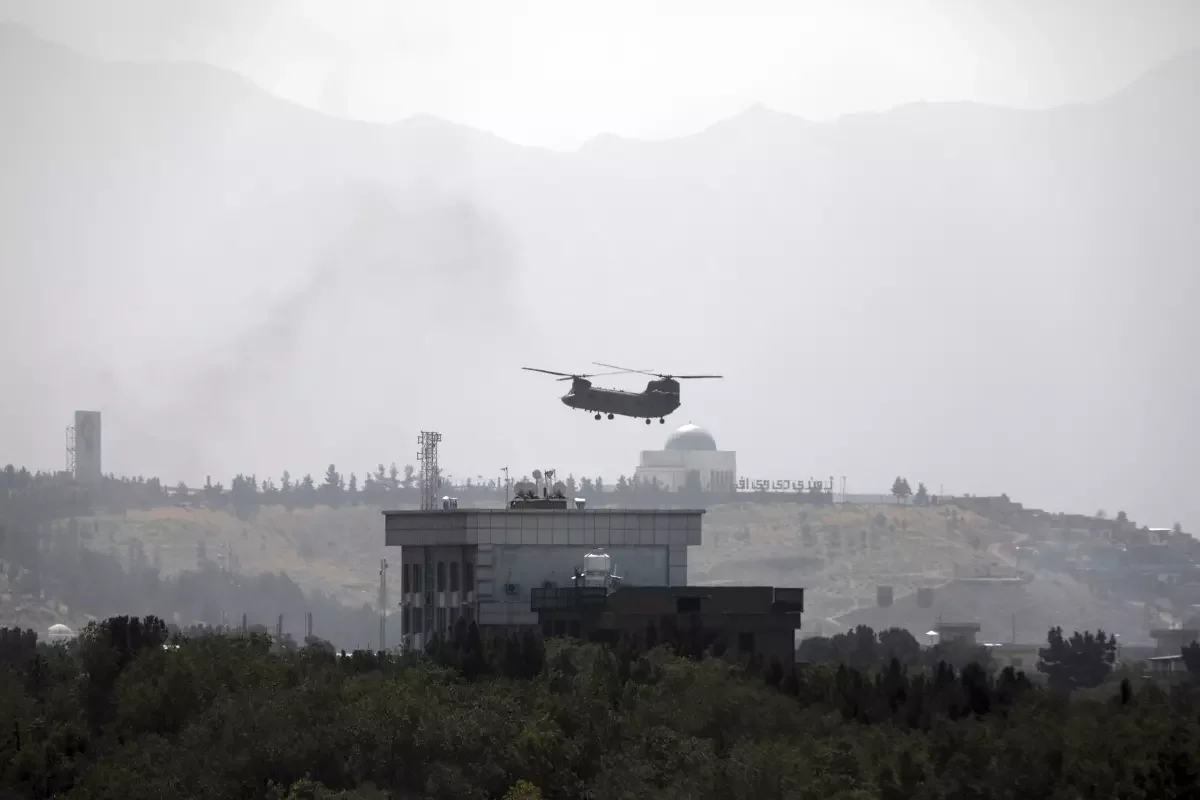
Fall of Kabul; Credit: Rahmat Gul
American involvement in Iran came as unexpected for the public at-large. Though there have been rumors of invasion since the Islamic Republic was founded in 1979, no one had expected in late February of this year that the US military would effectively execute an operation against Iran that would significantly deplete their army and kill the supreme leader. Recent escalation has not been taken to assure American power, but rather revived anxieties about intervention abroad. Many Americans do not believe that the war will be over, even as a peace deal seems to be on the table. Rather, many retain the belief that our military could remain bogged down in Iran --- in April, a poll found that seven-tenths of Americans were concerned of prolonged conflict. This sentiment is not simply responding to military strategy or the vague wargoals which we’ve placed on the war in Iran, but rather may be interpreted as having to do with a psychological phenomenon that has been snapping at our heels since April 30, 1975, and which has allowed for the creation of a cynical skepticism of not simply the morality of intervention, but the basic functionality of American power itself.
But first it might do us well to clarify why cynicism has consumed our discourse in the first place. In Richard Slotkin’s Regeneration Through Violence, he claims that the ‘taming of the frontier’ in American history --- the constant conflicts against American Indians that the first settlers, then the British crown, then the Americans waged in both casual and formal manner --- served to create an image of the country as morally righteous, always opposing and beating down others to legitimate a legend of moral purity. For decades afterward, even if this work might not have been verbalized in many spheres, both scholars and the press treated conflict at a similar level. Many saw ideology as the mythical spirit driving American expansionism, even as the true causes of conflict could end up being more sordid. But the issue is that even ideology does not fit the modern spirit of the times, because no one even tries to paint the current war as an ideological conflict. It is decidedly strategic and material. The federal government itself does not paint the war as one meant to protect values of freedom or self-determination --- regime change seems to be off the table --- but rather as a protection of American interests abroad. Conflict does not serve the strengthening of American moral supremacy, but of crude material strength.
Our entirely materialistic and inherently skeptical understanding of the current conflict can be explained through the Vietnam syndrome. The war in Vietnam fundamentally ruptured an understanding of America’s place in the world for generations to come, on both an ideological and geopolitical level. It had been painted as an idealistic war during its early stages, just like every other conflict that the country had faced. But it quickly turned out to bring the country to its knees after the 1968 Tet Offensive destroyed narratives of victory, and the following years would see antiwar activism and general public reluctance leave the federal government forced to gradually withdraw troops. In perhaps one of the most humiliating events in our public memory, in late April 1975 the military would evacuate all American military and civilian personnel out of the city of Saigon through helicopters. Failure in Vietnam, which had come at the cost of so many American lives and so many resources, was not just an embarrassment for the time being, but would shape America’s interactions with the world in the following decades. Attempting to recuperate, administrations would continue to attempt to ‘make up’ for Vietnam in increasing the defense budget and increasingly positioning America as an ideological stalwart involved in various conflicts: Grenada, Panama, and eventually the Gulf War. This is the syndrome --- America’s attempt to make up for the loss in Vietnam through exerting strength for the simple sake thereof.
Edward Said in 1991 once satirized early involvement in the Middle East; understanding its intentions, he alleged that many thought that it was “the Gulf War when ‘we’ finally rid ourselves of the ‘Vietnam syndrome’”. That conflict bears significant similarities to our late conflict in the Middle East: though we have not seen boots-on-the-ground in Iran, both wars saw rapid military operations quickly bring a formidable opposing army and its government down, without fully forcing regime change. Iran is an attempt to recreate the rapid success of that other war, but it has not been successful. Rather, a psychological phenomenon which almost exactly resembles the Vietnam syndrome has haunted us in the reality of American involvement in the Middle East in Iraq and Afghanistan. Most recently, the fall of Kabul in 2020 to the Taliban proved to humiliate American military might in demonstrating once again that militant third world radicals could foil the world police. Afghanistan was by no means an inexpensive war: an estimated $2 trillion was spent in involvement there, and over two thousand Americans were killed. Thus, we might co-opt Said’s observation about attitudes towards the Middle East for our own times: it is finally ‘Operation Epic Fury’ where we hope to finally rid ourselves of the Afghanistan/Iraq/Libya Syndrome. In fact, as previously mentioned, we no longer even need to appeal to some moralistic framework like those conflicts did; rather, wars seek to prove the basic ability of the American military to conduct successful operations. The skepticism regarding America’s military might in its involvement is not grounded in our troop strength or weapon technology, but is based primarily on anxieties about our past adventures in the sandbox. Across traditional, television, and social media, pundits warn of America being bogged down in Iran. Even as the conflict has reached a ceasefire as a peace treaty is being negotiated, skepticism, not of the realization of American ideals but of the success of simple strategic initiatives, remains high. The current unreasonability and cynicism that lacks any tethering to ideology but instead questions the basic functionality of the American military is explainable through the mainstaying relevance of the Vietnam Syndrome.
