
Revolution in Hungary
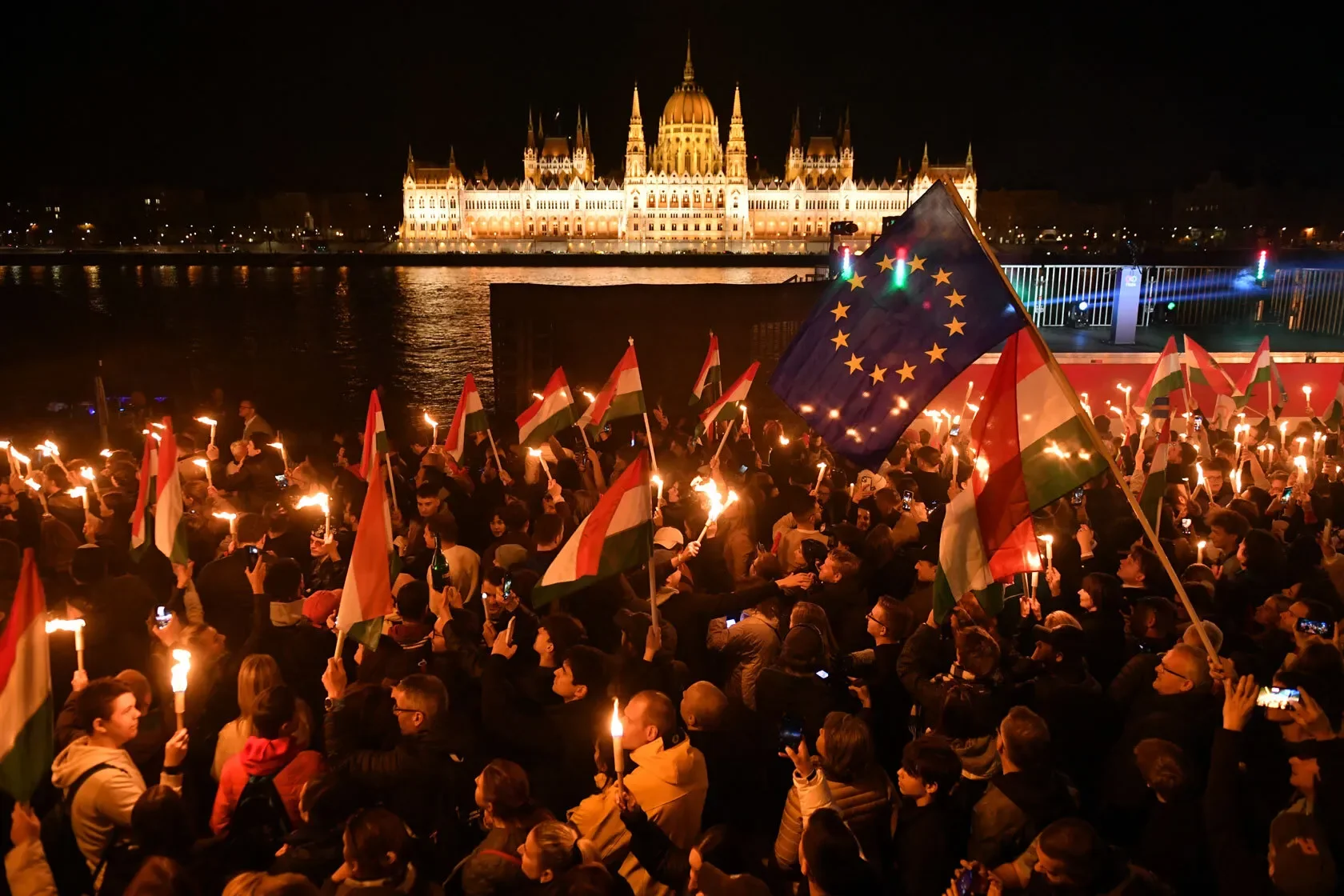
Supporters of Tisza by the Danube (Credit: Ferenc Isza for Getty)
The Central European nation of Hungary has experienced perhaps the most important event in its modern political history since its transition to parliamental democracy in 1989. In the decades following, the former Soviet proxy state has seen its citizens re-elect their entire parliament every four years, with the most recent election having taken place in April 2026. The 2026 election saw incumbent Viktor Orban --- prime minister of Hungary for sixteen years and leader of the Christian nationalist Fidesz party --- face off against László Toroczkai, of the far-right Our Homeland, and Peter Magyar of the center-right Respect and Freedom (also known as the Tisza) party.
In recent years, Mr. Orban has become a symbol of modern conservatism in Europe. As the post-Cold War world seemed to transform states into footholds of neoliberalism, Orban emerged as a reaction --- someone who wanted to form an “illiberal” democracy. He stoked the flames of culture war in the country, using agitating language towards immigrants, the LGBTQIA+ community, and the European Union.
Most recently, Fidesz held a convention with CPAC, the Conservative Political Action Committee which is a US based lobbying group. Attendees included prime ministers and presidents, like Javier Milei of Argentina and the German AfD party’s chairman Alice Wiedel. Also present was our Vice President, J.D. Vance, who echoed Orban’s rhetoric in criticizing the European Union for election interference and Ukraine in the current conflict against Russia. Vaunce, Wiedel, Milei, and others are leaders who have become icons in not only their respective countries but across transnational movements which have quarreled with pre-existing liberal political orders. That movement has not only gained special traction in Hungary, but has enmeshed itself within the country’s politics and society --- parliamentary and election rules were rewritten during the 16-year regime, and many of Hungary’s media and economic elites were close to Orban.
That is perhaps the most revolutionary aspect of Magyar's win. His victory isn’t groundbreaking in the sense of actual political discourse; he aligns with mainstream discussions in the EU regarding the organization’s anxieties regarding its own effectiveness, the ongoing war in Ukraine, and the immigration crisis. Rather, his victory, which has allowed for the Tisza party to hold 141 out of 199 seats in the Hungarian parliament, remains significant in ending the sixteen year reign of Viktor Orban, for whom political leadership had seemed inevitable into the 2020s, and whose decidedly illiberal attitude has now been replaced by a return to normalcy.
